Probate & Pre-Probate
How Much of St. Louis Probate Is Real Estate Inventory
Bottom line: about a third of St. Louis probate filings are homes the estate actually owned — not just an address where the decedent lived. Almost all of those still carry the family's name on title, months after the case opened. Pre-probate still gets you to the family first.
Wholesalers hear "probate" and picture a crowded list of stale leads. The data says something better, once you separate the homes the estate owned from the homes the decedent only rented.
Probate homes are still sitting — once you filter out the rentals
St. Louis County opens more than a hundred estate cases with a home attached every month. "Attached" means the decedent's address matched a county property record — and that is not the same as the estate owning it. We checked every match against the county's ownership records to find out which is which.
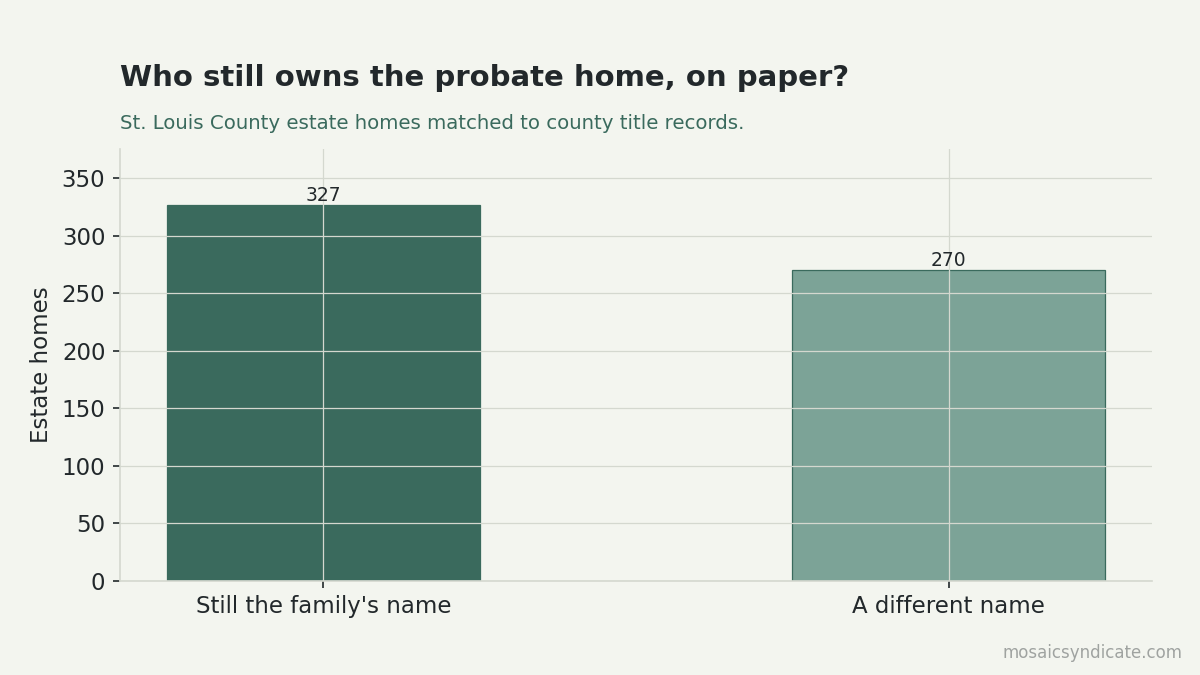
Of every home matched this way, about a third — 903 of 2,423 — are homes the estate itself owned. Close to half (1,134) turn out to be a former rental: someone else already owned the property before the decedent died, so there is no estate sale to be had there. The rest are not yet checked against ownership records.
Of the homes the estate actually owned, virtually all still carry the family's name on title, a median of about nine months after the case was filed. That is the real, still-sitting inventory — smaller than a raw address match suggests, but a cleaner number: it excludes places where the decedent was only ever a tenant. (A different name on an estate-owned title is not always a sale either; it can be an heir or a trust. The family-name homes remain the clearest "still available" signal.)
The hard part was never that the homes are gone. It is knowing which matches are real estate inventory and which are a former landlord's rental. That is the part we make easy — we check the owner of record against the decedent's family name and the county's ownership records, so you are not guessing.
The court filing is a late signal
Timing is where it gets interesting. We matched estate filings to the date of death, and the filing lands long after.
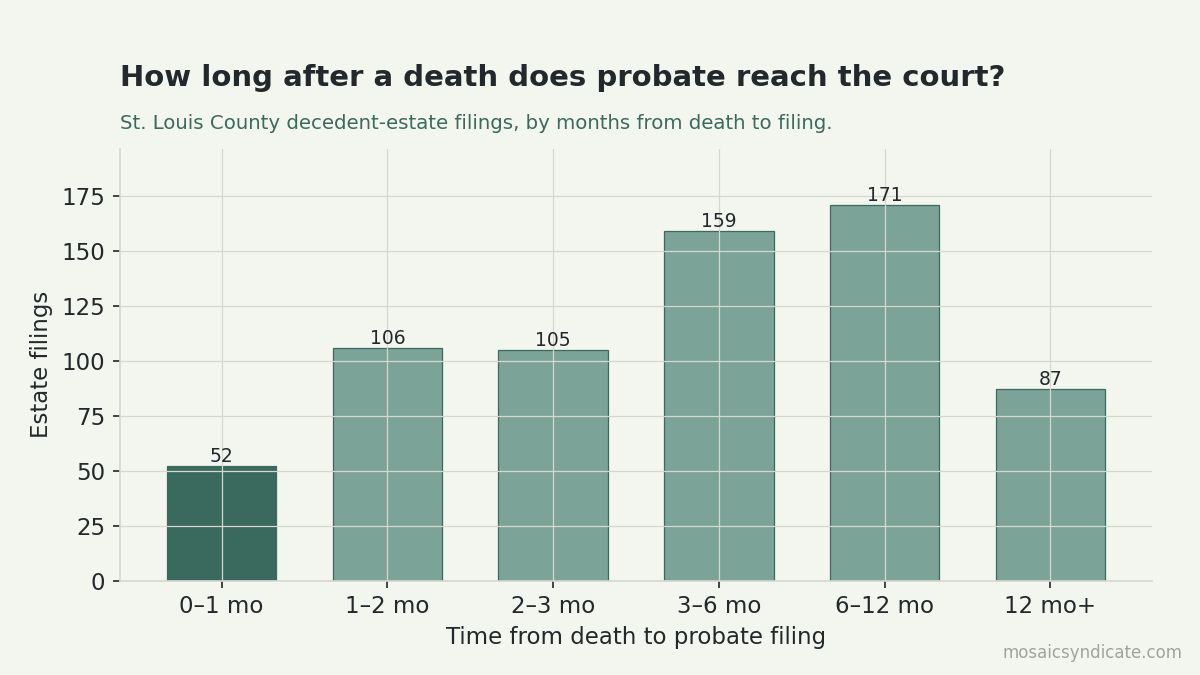
- Only 8% of estates are filed within a month of the death.
- 61% are filed more than three months later.
- The middle case takes about four months. One in eight takes more than a year.
So probate is not too late — the homes are still sitting. But the court filing is a slow clock. By the time a case is public, the death was months ago, and everyone watching CaseNet sees it on the same day.
Pre-probate is the head start
The window before the filing is the opening. A death notice — itself a public record — appears within days, months ahead of the court file. Work that window and you reach the family while the house is still quietly sitting in their name, before the CaseNet crowd shows up.
That is the leg up, and it is why we track both sides. We pick up the household from the death notice, match it to the property, check the title, and line up the contacts — so a pre-probate lead is not just early, it is ready to work. (Even the court filing is not the day someone can act — here is what CaseNet does and doesn't tell you.)
Probate is real, estate-owned inventory you can find today, once you know which matches actually are estate-owned. Pre-probate is the same inventory, weeks or months earlier, already worked up. Both come from the same effort: watching the death side and the court side together.
A note on the numbers
Correction (2026-07-11): this page previously reported that "more than half" of probate homes still carry the family's name on title (about 55%), and called that "real inventory." That figure counted every address match, including homes the decedent only rented — a rented home was never the estate's to sell, so grouping it with true estate homes overstated the inventory. We now check every match against the county's ownership records and report the estate-owned figure (about a third of matches) separately. The title-status chart above has not been regenerated against the estate-owned filter; read it as the raw address-match split, not the estate-owned split, until it is.
These come from St. Louis County records over the months we have tracked. We matched homes on the death date and the owner of record, and a few things are worth knowing. The death date is self-reported in the filing. The county recorder is slow — title changes often post weeks or months after a sale actually closes, so a few homes still listed under the family name may have already sold. And a name match on the owner of record is a heuristic, not a legal confirmation — it can be fooled by a coincidental surname. Treat the figures as a strong signal, not a live feed. The shape holds: the estate-owned homes are still sitting, and the filing is late.