Probate & Pre-Probate
Scored Before You Spend
Bottom line: every probate lead list already does the ownership match and the skip-trace — you get a stack of names with phone numbers attached. What none of them do is rank the deals. So you work the list in whatever order it arrived, with no read on which call is worth making first. These five are ranked: each arrives scored on value, rent, gross yield, title structure, and days since the death notice — so the order you work them is the order they are worth.
Below are five properties from a recent St. Louis County pre-probate set, surfaced before any probate filing hit the docket. The names are matched and the contacts are in hand — that part is table stakes. Names and addresses are withheld here. What is shown is the part that decides where you start: the score behind each one.
Five leads, already worked out
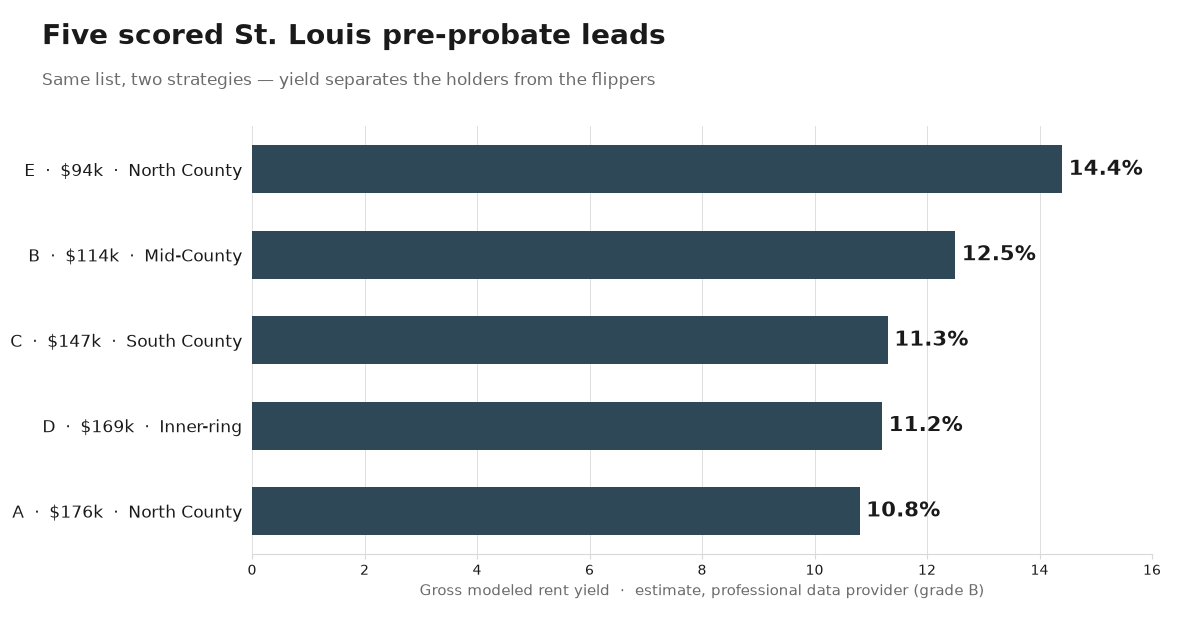
| Lead | Area | Est. value | Modeled rent | Gross yield | Title | Days since death |
|---|---|---|---|---|---|---|
| A | North County | $176,000 | $1,580/mo | 10.8% | Sole owner | 9 |
| B | Mid-County | $114,000 | $1,190/mo | 12.5% | Sole owner | 43 |
| C | South County | $147,000 | $1,380/mo | 11.3% | Sole owner | 53 |
| D | Inner-ring | $169,000 | $1,580/mo | 11.2% | Sole owner | 80 |
| E | North County | $94,000 | $1,130/mo | 14.4% | Sole owner | 90 |
Values and rents are estimates from a professional data provider (grade B in our sourcing scale), not appraisals. Yields are gross and modeled — they name the cash-flow signal, not a guaranteed return. Read them as a screen, not a closing statement.
What the columns are telling you
Yield separates the holders from the flippers. Lead E carries the highest gross yield at 14.4% on the lowest entry price, $94,000 — a buy-and-hold profile: low capital in, strong rent relative to price, a north-county market where the rent holds better than the resale does. Lead D is the opposite — $169,000 in an inner-ring market that resells and appreciates, where a flip exit is the cleaner play. Same list, two strategies, and the number tells you which lead is yours.
Title structure decides whether there is a deal at all. Every lead above reads sole owner, which means the property has to pass through the estate before it can convey — that is the case you can win. A property held jointly by a married couple usually passes to the surviving spouse outside probate, and no sale is forced. We flag that distinction on the lead, so you do not spend a skip-trace on a house that was never going to come to market.
Days since death is the part that decays. Lead A is nine days out. Our own record of St. Louis County probate sales puts the institutional buyers' window at a median of 49 days from filing to sale, with the middle half inside a 33-day band. Families that sell move on a tight clock once the case opens. A lead worked at nine days and one worked at ninety are not the same lead, and the column says which one you are holding.
Matched and skip-traced is the floor, not the edge
A list that hands you matched, skip-traced names has done the easy part. It has told you who to call. It has not told you which call is worth making, or in what order. On a stack of a hundred names that is the difference between a productive morning and a wasted one — and it is the part every list leaves to you.
A death notice tells you a death occurred. It does not tell you whether there is real estate, whether there is equity, whether the rent would carry a hold, or whether the title even permits a sale. We answer those four questions and turn them into a rank, so the first decision you make is not "is this real" but "is this the one I call first."
The five above are a representative slice. The full set runs deeper across the same St. Louis County footprint, refreshed as new notices land and re-scored as the property and title records fill in. Each one arrives matched, skip-traced, and ranked — withheld where the data is thin, graded where it is estimated, and quiet about what we cannot yet confirm.